

By the Traveller team · Updated September 2026
Kyoto was Japan's imperial capital for over a thousand years, and unlike Tokyo it was spared large-scale wartime bombing — the temple density and old wooden streetscape here are genuinely intact, not reconstructed for tourists. The whole day stays inside Higashiyama, eastern Kyoto's single most walkable temple district: down from a hilltop wooden temple, through stone-paved lanes that have carried foot traffic for centuries, along a canal-side path named for a philosopher's daily walk, closing at a shrine with thousands of vermillion gates that never actually closes. Kinkaku-ji, the Golden Pavilion, is real and beautiful but sits in a different part of the city entirely — it doesn't fit this day's walkable geography, and forcing it in would break the route rather than improve it.
Why walk Kyoto?
- Kyoto is famously flat and pedestrian-friendly, with well-marked paths connecting its major sights — no real climb anywhere on this route, unlike the site's hillier guides.
- Higashiyama's preserved stone lanes, Sannenzaka and Ninenzaka, are car-free streets that have carried foot traffic between temples for centuries, not a modern pedestrianization.
- The Philosopher's Path is a real, named canal-side walking route — a built-in change of pace between temple stops, not just a shortcut.
- Fushimi Inari's thousands of torii gates are free and open at all hours, rewarding an unhurried wander rather than a single quick photo.
A one-day itinerary
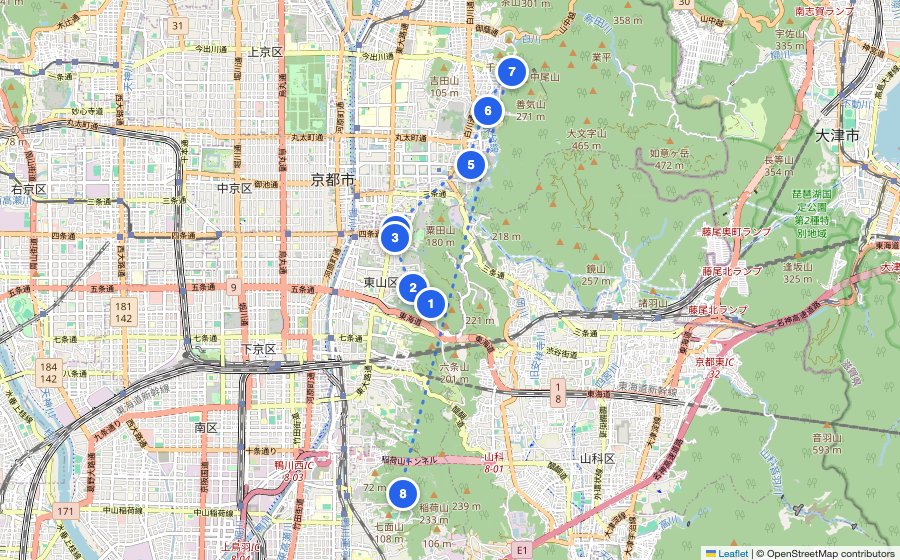
Morning
Kiyomizu-dera
A hilltop wooden temple built without a single nail, with a real wooden veranda looking out over the city — start here before the day-trip crowds arrive.
Sannenzaka & Ninenzaka lanes
The stone-paved streets just below the temple, lined with tea houses and craft shops — genuinely centuries-old, not a recreation.
Midday
Yasaka Shrine
Gion's gateway shrine, free and always open — the natural hinge between the temple lanes and the geisha district.
Gion (Hanamichi-koji)
Go for the preserved wooden architecture and atmosphere — a real geisha sighting is rare and shouldn't be expected, whatever the postcards suggest.
Afternoon
Nanzenji
A large Zen temple complex with an odd, memorable Meiji-era brick aqueduct running straight through the grounds — a genuine surprise inside an otherwise classical temple.
Philosopher's Path
A canal-side walk north toward Ginkaku-ji, named for a 20th-century philosopher's daily route — an unhurried stretch after two temple stops.
Evening
Ginkaku-ji
The Silver Pavilion — it was never actually silvered, and the name is more romantic than the building itself, which is fine to say plainly rather than oversell.
Fushimi Inari Taisha
A separate late-day finish (a short train ride from this cluster, worth the one honest transit hop) — thousands of vermillion torii gates climbing the hillside, genuinely worth visiting after day-trip crowds thin out.
Practical tips
- •Most temples run roughly 8:30/9am to 5pm — plan the Kiyomizu-dera start accordingly so you're not arriving to a closed gate.
- •Temple interiors are shoes-off — slip-on shoes save real time and hassle over anything with laces.
- •Fushimi Inari has no closing time and is genuinely at its best in the evening, once the day-trip crowds have thinned out.
- •An ICOCA or Suica IC card covers the one bus/train hop this route needs, and works city-wide beyond that.
Common questions
Can you see Kyoto's highlights in a day on foot?
Yes, comfortably, if you stay inside Higashiyama — Kiyomizu-dera down through Gion, Nanzenji, and the Philosopher's Path to Ginkaku-ji forms one connected walk, with Fushimi Inari as a short train ride to close the day.
Is Kyoto a flat and walkable city?
Very — Kyoto is genuinely flat with well-marked paths, unlike hillier guides on this site. Nothing on this route requires a real climb.
What's the best time of year to walk Kyoto?
Cherry blossom season (late March–early April) and autumn foliage (November) are the classic answers, and genuinely beautiful — but also genuinely the most crowded weeks of the year, worth knowing before you plan around them.
Should I visit Kyoto or Tokyo first?
They're different trips rather than a ranking — Tokyo is scale, neon, and modern density, while Kyoto is unhurried, traditional, and temple-dense. Most itineraries end up doing both.
More general questions about Traveller? See the full FAQ →
Wondering whether a self-guided route, a paid tour, or AI planning is the right call for Kyoto? Compare the options →
Want this itinerary tuned to your exact day?
Traveller's AI builds a personalized route for Kyoto — your time window, budget, and vibe.
Create your free route →You might also like
More city guides